

Welcome, aspiring polyglot! Recently, I was talking to one of my students who was finishing her class about the feeling of inadequacy that comes with knowing “enough”. One of the problems with learning a new language is that “enough” to communicate is not the same as the “enough” it takes for fluency. In fact, the former is just “enough” to make you crave the latter.
During our discussion, I brought up a famous graph. The Dunning Kruger:
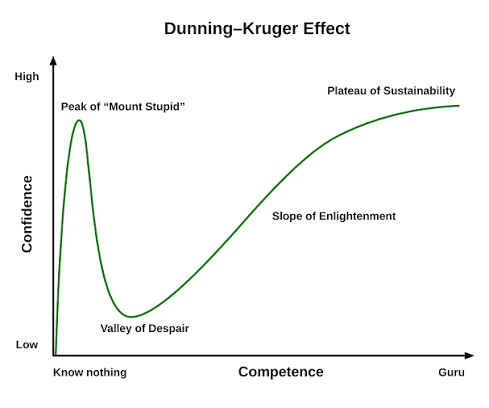
Something I didn’t say, that I probably should have said, is that there are people on this graph. That is to say, you are not alone on this graph. There are people permanently in the Valley of Despair and their are people along the Slope of Enlightenment. There are even people waiting at the Plateau of Sustainability. Who you listen to during your journey will have various effects.
The receiver side of Dunning Kruger
Something I realized talking to another student the other day is that most of the time, anyone who knows more than you is going to be on your side. Very rarely will you come across someone who knows more than you and is against your progress. Unfortunately, the same cannot be said for people who are in the Valley of Despair indefinitely.

The problem is that same one we all face: it’s incredibly difficult. Anywhere in life where you do difficult things, think about the people you’ve met through the process of getting to where you are now. I would all but guarantee you can map them onto this graph somewhere. When you are first starting out, everyone knows more than you, so you can just absorb.
While on The Slope, you will encounter three types of people. The first is a group of people just like you. A group that is working to progress out of The Slope and onto The Plateau. Those peers are able to help and hinder you, but none of them likely want to see you fail. However, there is a group in the Valley of Despair that will never leave.
It is too much work to get to the top and it is far easier to drag people down and keep them at your level. Ironically, the Valley of Despair can become a place of comfort. One need only despair if they plan to reach the next step on the path. In fact, the despair aspect doesn’t even come from the next step. It comes from the realization that there are drastically more steps than initially anticipated.

Do what you can to avoid these energy leeches. They have nothing to offer you along your path. Instead, try to seek out people in the third category. The WAGMIs or the We’re All Gonna Make Its. People who have accomplished your goal and would like nothing more than to see countless others accomplish the very same goal. Atop the plateau they await, but a few will help along the way.
Listening to bad advice
Bad advice is where things truly go wrong. The problem is that most people are not aware that they are giving bad advice. In fact, a great many of them believe they are giving good advice without understanding the long term effects. We can take my favorite two examples in Spanish. This is what public schools teach in the US. In Spanish:
Hasta mañana = See you tomorrow
Hasta luego = See you later
Hasta pronto = See you soon
Me llamo = My name is

Now, for those of you who have been in class with me or have been reading these for a while, you will already see the problem. For those who don’t see the issue, this is also why flashcards are tough in language education. If you want to know why, read this:
Is Anki Good for Language Learning?

Welcome, aspiring polyglot! Nearly every day someone asks me if they should be using flashcards and my answer has been the same for years now: probably not. There are use cases for flashcards, to be sure, but using them to learn a new language is neither effective nor efficient. In fact, you may be hurting yourself more than you are helping.
So, hasta has come, for many, to mean “see you” and that is simply not what it means. Hasta means until. Learning it as “see you” causes a ton of problems later down the line since until has far more uses. The same goes for “llamar”. If you treat “llamar” as the verb for “my name is” then when someone tries to call you, there will be a lot of confusion. Llamar means to call.
Worst of all, if teachers just took the time to go through what these things actually translate to rather than what they mean (crawl before you walk before you run before you fly) then it is the perfect opportunity to address indirect object pronouns and reflexive conjugations. Me + llamo = I call (yo llamo) + myself (me). Far more useful in the short, mid, and long term.

Yes, the process of teaching the meaning over the translation is faster. But for every two steps you take forward using this method, you will take one step back and it will take longer to progress because now you have competing ideas fighting in your head. It takes 21 days to develop a good habit. Which means it takes 21 days to break a bad habit. You don’t deserve to lose out on that time.
Incorrections
Unfortunately, much of this is a consequence of taking advice from people who are at the Peak of Mount Stupid. As incoherent as it is, people at The Peak are far more likely to give advice than people who have reached the Plateau. Logically it makes sense, too. At The Peak, you still haven’t realized how little you know. Every thing you learn feels like mastery.

Not until the Valley of Despair, are you truly able to recognize just how much more you have to accomplish in order to hit your goals. Listening to people at The Peak might seem like a good idea, but do not be fooled by their unearned confidence. The problem here is that anyone who is confidently giving advice is either a master or a novice. There really is no in between.
So, how are you supposed to tell the difference? It’s not easy. Therefore, rather than trying to sus out who is right, I recommend that you trust, but verify. Believe the advice, but look into it. Chances are whatever you were told is partially true. Your mission is to figure out where the truth stops and the inventions begin. Much easier said than done to be sure.
But this verification process is simply another tool in your toolbox for the foreseeable future. Any time you are learning anything it will be something you need to break out to progress in the most effective and efficient way possible. Ultimately, you will be in charge of doing this for yourself, but luckily for you I have already written an article on how to do this well:
Check Yourself Before You Wreck Yourself

Welcome, aspiring polyglot! A leading indicator that you are well on your way to fluency in your target language is the ability to self correct. Making mistakes is part of the game, by now that should be clear, but that does not mean making the same mistake is part of the game. It should be your goal to stop making whichever mistakes you are making as q…
Conclusion
Experience is an interesting concept because there are too many variables to count when calculating someone else’s. That is why it is helpful to categorize people who are offering help and the Dunning Kruger graph offers the perfect heuristic. Sometimes you may be surprised, particularly by the fact that the most experienced are often the most hesitant to share absolute advice.
Learning to accurately discern is a skill that extends far beyond language acquisition. Mastering it, however, can be done through language acquisition and later applied to other areas of life. It will be difficult, but you can do difficult things and be great. So go out and do some difficult things and become great. I am rooting for you.

If you’re stuck in the gap between understanding and speaking, you’re not alone, and you’re not broken. The Guides library (paid subscribers) includes structured output protocols designed to bridge exactly this gap, day by day.
The fastest way to break through is with someone who can hear you, correct you, and push you in real time. That’s what my private courses are built for. Read what students say about the experience.