

Welcome, aspiring polyglot! If you grew up going to an American public school, the odds that you have heard “I don’t know, can you?” in response to the question, “Can I go to the bathroom?” are pretty high. In fact, I would be surprised if you hadn’t heard that before. Unfortunately, most of the teachers doing this in school never took time to explain why they are doing it.
Engaging classes
I recently found myself in the middle of controversy because I happen to believe kids should be able to use the restroom when they need to use the restroom. Of course there are others who ruin it for everyone else, but that does not seem just to me. Beyond that, if a class is engaging, students will rarely ask to excuse themselves; and when they do, it is usually for good reason.

After teaching for several years now, one of the things I have had to grapple with is the fact that anything longer than an hour is too much time. Without fail, every single one of my students is running out of processing power between minute 45 and minute 60. To me, this is a good thing. If you are actually exerting yourself full beans for an hour, you should feel mentally exhausted by the end.
Regrettably, the system as it is set up cannot operate in a way that is advantageous to the individual. Even though individualized education is demonstrably more effective, especially with regards to foreign languages. No two students should have the same class, but that is simply not feasible when class sizes have surpassed 30 students to one teacher.

Fortunately for you, your education is in your hands and you can choose the things that are actually interesting to you. For more on how to create your own language learning curriculum, see this article:
Building Language Learning Materials

Welcome, aspiring polyglot! An interesting piece of growing up is learning that adults by and large do not know what they are doing. As a kid, when you think about how things will be when you become an adult, it is easy to believe that everyone knows what they are doing and that everything runs smoothly. Unfortunately, that is rarely the case and so it …
The only thing you have to do is start. From there things get much easier. After finding a rabbit hole to follow, your only job is to, well, follow it. Thanks to my students I know more about the olive harvest in Spain than most people ever will, more about the surf conditions of El Salvador than I ever thought I would, and more about horror novels as a whole than I had previously been interested in knowing.
Your only limit is your creativity and imagination. There are tons of materials out there available for you. That said, it could be that material is not what is holding you back. In fact, for many native English speakers, one of the greatest hurdles is understanding grammar constructs within the English language. Without that understanding, applying them to new languages is impossible.
The subjunctive mood
The reason teachers would bring up the “may” versus “can” thing in school is because there actually is a grammatical mechanism to it. In the romance languages this is called the “subjunctive” tense or mood. All that it does is imply doubt. That’s it. That’s the whole complex mechanism. A “tense” that implies doubt. Fortunately, in English, it is a word and not a tense.
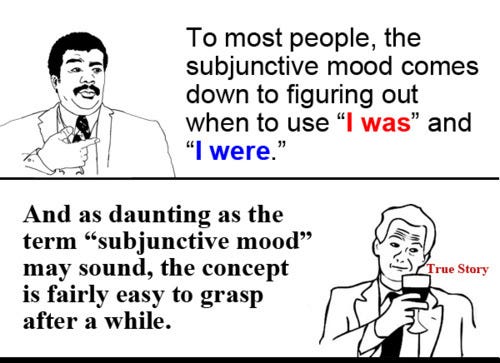
Similar to how “would” and “will” are words instead of tenses in English, “may” is how you use the subjunctive in English. It just turns out that in the year 2026, it is no longer very common. Using these correctly in your target language becomes a lot easier when you are able to understand why and when you might use it in your native language. For more of these, check out this article:
How to Master Grammar in Romance Languages

Welcome, aspiring polyglot! I have long fallen on the vocabulary side of the debate when it comes to determining whether grammar or vocabulary is more important when learning a new language. A large part of this is that I view grammar, particularly conjugations, as an extension of vocabulary rather than a separate beast in and of itself.
But what if you get it wrong? This is something I think far too many people over think. There are some areas of Belgium and France where the French subjunctive is hardly being taught anymore. As sad as this is, what it means for you as a French learner is that when you are able to employ it correctly you will appear to be a well educated French student, even if you don’t always use it properly.
Improving your English skills
Very few people who are fluent in English understand the rules of English. As a rule, most native speakers do not understand why they do many of the things that they do. Therefore, by learning just a few mechanism, a couple of grammar terms, and why and how they work in English, you can set yourself apart from the average language learner.

Some things will help more than others, but when it comes to romance languages, here is what you need:
The difference between and use of indirect and direct objects
Why and when you use adjectives versus adverbs
This is particularly helpful with regards to “good” versus “well” in English as in every romance language.
Word order
Possessives
This is the age old joke of “their” versus “there” versus “they’re” but is just as important for “who’s” and “whose” and “your” and “you’re” and so on.
Mastering these concepts in your native language will make each subsequent language you learn far easier. As it stands, I have to spend several hours teaching native English speakers the particulars of their native language in order to facilitate the comprehension of mirror concepts in foreign languages. That is why I want you to take the time yourself. It will pay off quickly.
Conclusion
Personally, I was never the type to ask to use the restroom in school unless I absolutely had to use it. According to the controversy I found myself in last week, this is no longer the case for the majority of students. Hopefully that means the teachers are still using this age old trick to avoid saying yes; and hopefully they are taking the time to explain why they are doing it.
While that may have never happened for me, I always appreciate, and can tell, when a student of mine had a quality English teacher. If you didn’t, and even if you did, reviewing grammar structures and syntax rules in your native language will enhance and accelerate your second language acquisition. It is difficult, but you can do difficult things and be great. So get out and do some difficult things and become great. I am rooting for you.

Exams reward a specific kind of preparation that most self-study methods don’t provide. Paid subscribers get access to exam-focused strategies and frameworks in the Guides library designed to complement what you learned in this post.
Need to hit a score by a specific date? I build exam-specific private courses with targeted preparation for TOEFL, CLEP, DELE, DELF, and more. One of my students passed his TOEFL and got accepted to a New York university after working together for three months. Read his story and others here.
I doN’T KnOw CAn yoU?
Raigebait successful.