

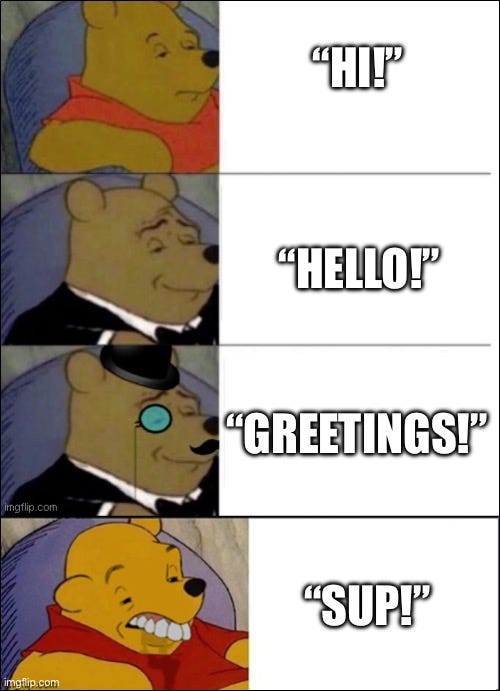
Welcome, aspiring polyglot! I have been thinking about the concept of mental agility quite a bit recently. Primarily because it is the best name I can put to the idea of being able to think about the same idea 3 different ways. By that I mean, being able to say the same thing 3 different ways with varying degrees of formality. For language learners, this skill is crucial to develop early and often.
HIIT
For those who don’t know HIIT stands for “High Intensity Interval Training” and it’s equivalent in language acquisition is transcription. The goal of HIIT training if to gain a large benefit in a short amount of time, to avoid diving too deep into the weeds. Transcription is precisely that tool in language acquisition and it is one of the main levers you can pull to increase your stress tolerance threshold.
In fact, a good HIIT workout is between 20-30 minutes. That is the max amount of time I recommend doing transcription on a given day. As shocked as people often are by that, the truth is after 30 minutes (20 really) the frustration will build to such an extent where it become counterproductive. 30 seconds on 30 seconds off. 30 seconds listening, 30 seconds writing.
This remains, hands down, the greatest tool for learning to understand a language at native speed that I have ever found. While I have many recommendations on how to train the ear, this is the most potent. If you want to read more on why, you can do so here:
Comprehensible Input Made Easy

Welcome, aspiring polyglot! People often ask me how many hours per week they should commit to their target language. In general, one hour per day is a pretty safe answer. However, that comes with the massive asterisk that you need to be actively using that hour, for the whole hour, every day. The reality is quite different from this theoretical minimum.
HIIT training, transcription, is something that you should do more days than you don’t. Assuming you would like to reach proficiency within the next 6 months. 4 days per week, taking every other day off. I tell me students this often, but the more you do it, the less time you have to spend doing it. Suffer a lot now to become proficient quickly or don’t suffer at all with a 2000 day streak on Duolingo.
Weight training
Your weight training days of language acquisition are the days where you spend a lot of time reading and writing. Consumption is easy, but you will make the most gains through production. Using your recall is, to me, the equivalent of lifting weights. Your brain has to work pretty hard to move things from your memory to your working memory. The more you do it, the easier it becomes.

I also like this analogy because you can choose your “weight”. That is to say, you can choose how many sentences you write, what you write, how much help you allow yourself to use (ideally none), and what success is defined as. Your only competition becomes your logbook, your notebook, and you can focus entirely on progressively overloading yourself towards fluency.
Here’s a good example of what that looks like in practice:
Choose a topic you want to be able to discuss in your target language
I implore you to go beyond “order food” or “buy x thing”.
Choose your success metrics
How many words?
How many sentences?
What level of “perfection”?
Are you okay with incorrect gender
Are you okay with incorrect conjugations but of the right verb?
Are you okay with typos? etc
Write about the topic.
A good way to get new vocabulary into your routine is to find 50 words related to the topic of choice and write them down somewhere first, or at least have them visible. Then, write them directly into as many sentences as possible.
Wait 24 hours
Return to the topic and do it all again. This time, however, try to add 1-2% more. Three more sentences, five more vocabulary words, one less mistake.
Repeat until comfortable with the chosen topic
Choose a new topic
Repeat infinitely

It really is that simple. Note, though, that I choose the word simple and not easy because, while it is simple, mastering a new language is anything but easy. One thing that can make it a little easier, though, is a bit of mental speed training.
Speed training
When I was a kid, our school had a summer program for athletes called “speed training”. It was a serious of drills that we would do with the end goal being the ability to reach higher speeds during our respective sports. Anecdotally, it was successful. Within the realm of language acquisition, we have the opportunity to do the same thing.

I really like the idea of drilling parts of the whole in order to improve the whole; and since we are talking drills it means we get to play with variety. Something that has always made studying easy for me. You should choose 5-8 drills and do them for 1 hour. Here are some ideas for “speed” or “agility” drills:
Say the same thing
Write out 5 sentences in your normal way of speaking. Do not change to try and use words that you know in your target language. That largely defeats the point of this exercise. Once you have your 5 sentences, write them all 2 different ways (so you have a total of 15, the 5 original + 10 new). The idea is to express the same idea in 3 different ways using as much different vocabulary as possible.
BONUS: Rewrite them all in your target language. Use reverso.com to help with any words you don’t know.

Paraphrase
Find an article in your target language that you could see yourself discussing with someone. This could be home decor, gardening, outdoors, fitness, anything. Read the whole thing, using any translation help you need along the way. Once you are done, write a summary that covers all of the major points and maintains the majority of the meaning. Try to limit yourself to 50-60% the original length.
Disclaimer: Even if you just do these drills in your native language, you will be doing yourself a service; and when you are doing it in your native language, you can mostly do it in your head. The writing is more important for your target language study sessions.

Synonyms
If you do nothing else, do this. I cannot think of a more valuable skill when learning another language than the ability to accurately define words and identify their synonyms. It comes up every single class. And I ask, because I want my students to develop this skill in both their target language and their native language. But you need to be asking yourself as well.
Here is a small example of two words that I go through this with for every Spanish student:
Inundar
Profundo
Just by looking at these words, you can probably surmise the correct direct translation, but do you know what they actually mean? Because if you said inundate, you are correct. That is what the translation is. But when las calles están inundadas por la lluvia the streets are flooded due to the rain.
Profundo does mean profound. But un lago profundo is a deep lake. These are the synonyms you need to be able to see without seeing them. If you can develop that skill, you will be unstoppable. The practice is easy.

If your target language is Latin or Germanic based, it is worth looking into the cognates between it and English. Using those cognates, try to find synonyms and you might otherwise use unintentionally. After all, I believe most of us would say deep instead of profound in our daily lives. That said, this is a demonstration of why English is such a beautiful language. Don’t believe me? Look up the German word for deep.
If your target language does not have those bases, then start in your native language. Think of a few (3-5) words and go through as many synonyms as you possibly can for those words. Write them down and translate them into your target language. You might be surprised by one or two being more similar than you would have thought.
Conclusion
It is easy to forget that your brain is essentially a muscle and it needs to be trained as such. That also means it is going to be important to rest sufficiently in order to give your brain enough time to grow effectively. The variations in your training will reflect in your linguistic abilities, so make sure to work every one of these exercises into your language learning routine.
Not only will the mental agility become evident relatively quickly in your target language, you will notice reverberations in your native language that lead to you being a better, all around more effective communicator. It will be difficult, but you can do difficult things and be great. So go out and do some difficult things and become great. I am rooting for you.

Everything in this post is part of a larger system. If you want the full methodology in one place, 3 Months to Conversational is available now on Amazon. It’s the same framework my private students use, designed for independent learners.
If you want that framework customized to your target language, your goals, and your schedule. Check out the private course options.
Excellent advice- great tips- some good points to use, acquire, practice !
Thanks !!