

Welcome, aspiring polyglot! Grammar is one of the first things we do in my classes, but it also one of the things we work through quickest. In my opinion, and experience, grammar comes. What matters more than mastering every grammar structure in a new language is becoming acquainted with them so that you can recognize them, even if you do not employ them perfectly.
English grammar rules
For as much as people tend to believe grammar is important, the vast majority of native speakers struggle to speak their native language with perfect grammar. This is especially true for English speakers, though native German speakers often mess up their grammar. Of course, German grammar is far more complex, but the point remains. Perfect grammar is largely a fever dream.

A major sticking point for native English speakers learning new languages are prepositions. About, for, on, at, by, to, and dozens of others cause major issues because, well, most English speakers cannot explain why they use them and when it is appropriate. In this instance, let’s take the word “for” as an example.
When you say for, do you mean you are making an exchange? I will give you two of these for one of those.
Do you mean you are in favor of something? I am for the freedom of expression.
Are you trying to explain a reason you did something? I did it for you.
And these are just three examples. Unfortunately, the versatility of the word “for” means that you may need to learn up to 5 words in your target language in order to properly express all of these ideas that only require one word in your native language. Let alone the fact that that is merely one of the dozens of prepositions that carry multiple uses in every language.

This is to say nothing of contractions and the myriad of people who fail to use them correctly in English. Mixing up “they’re”, “there”, and “their” is bad enough in English, but it is horrendous to make this mistake when translating in your head to another language. This is why I am so adamant about understanding one’s native language before learning a new one.
Finally, a problem in English that doesn’t exist in the romance languages is that of having words that, in the romance languages, are actually tenses. Those words are “might”, “may”, “will”, “have”, and “would”. I have a full write up on that you can find here:
How to Master Grammar in Romance Languages

Welcome, aspiring polyglot! I have long fallen on the vocabulary side of the debate when it comes to determining whether grammar or vocabulary is more important when learning a new language. A large part of this is that I view grammar, particularly conjugations, as an extension of vocabulary rather than a separate beast in and of itself.
When you can afford to mess up
You can’t! Just kidding. Honestly, depending on the language of course, there are very few things that you cannot afford to mess up. Verb conjugation is one of the things most people get hung up on during the beginning stages, but so long as you get the timing right, you can work towards getting the person right. In fact, even if you get the timing wrong, using the correct word is more important.

Think about this in your daily life. Have you ever been speaking to someone who said, “We go to the store tomorrow”? Obviously “we are going to the store tomorrow” is correct, but you understand the message being conveyed nonetheless. The same is true when you are speaking to just about anyone. Unless they are an unreasonable person, conjugation mistakes are far from the end of the world.
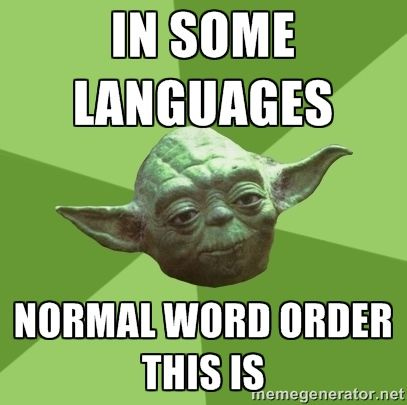
Another very common aspect to languages that far too many people take far too seriously is word order. Yes, word order is important, but it is, again, one of the areas where you can afford to mess up, so long as you are using the correct word. Word order will work itself out with time. After all, you can only encounter so many examples before the correct formation begins to stick permanently.
The same is true of gendered words. In the vast majority of cases, using the wrong article with a word or failing to use the appropriate ending with an adjective is not a problem. Over time you should strive for perfection, but perfection is impossible. Very few people, if any, are actually capable of speaking a language perfectly. Using the right word is far more important.
Foundational structures for fluid speech
Since all of these things can become more fluid with practice, the foundations you need to put in place immediately are, in fact, the same as the areas of speech where you can afford to mess up. Mistakes are incredibly important for foundation building. Knowing what not to do is often more helpful than knowing what to do. The fastest way to learn is to fail early and often.

Word order is one of the first things you will be introduced to and it is something you should have a cursory understanding of from the start. However, that does not mean you should wait until you understand it perfectly to begin using the language. Most language are replete with exceptions and the most expedient way to learn the exceptions is by treating all rules as hard rules.
The same is true of verb tenses. You should learn the past, present, and future. Being able to correctly use each of the three will ensure that, at the very least, the person with whom you are speaking knows WHEN you are talking about, even if the WHO you are talking about is less than clear. This is why we cover 6 tenses in 6 weeks during my classes. Using them is the best way to learn them.

Finally, learning descriptive words is important for a sturdy foundation due to the fact that they will often open up several vocabulary vectors for you. If you know slow then you know slowly and to slow and slower and slowest. Each new vocabulary word you learn gives you the opportunity to build a deeper understanding of the language.
Descriptive language is great because it allows you to be more eloquent in your speech. It also forces you into mistakes with regards to word order and gendered words which is feeding not two, but three birds with one scone. At first you will have to express yourself however you can express yourself, but your goal is, and should be, to express yourself however you want.
Conclusions
Learning a new language is often less about rules and more about balance. If you focus exclusively on the rules, you are going to paralyze yourself into silence. Striking the perfect balance between progressing towards perfection and speaking with delusional confidence is easier said than done, but that is what makes it the perfect goal.
Do not fall into the trap of seeking perfection, especially not in the first year of your language acquisition. Improvements will come, but only if you are willing to put yourself out there and sound stupid. Otherwise you will hypothetically speak well, which doesn’t mean much to anyone at all. Effort, on the other hand, means the world to people who speak your target language natively. It is difficult, but you can do difficult things and be great, so do some difficult things and become great. I am rooting for you.

Second Language Strategies is a reader-supported publication. The strategies in this post are a fraction of what’s available to paid subscribers. The full Guides library, including The First 30 Days blueprint and advanced acquisition frameworks, is waiting for you on the other side.
If you’re ready to stop reading about language learning and start doing it with personalized instruction, learn about my private courses here. 28 out of 28 students have spoken their target language after completing the program.