

Welcome, aspiring polyglot! For those who are learning a new language as part of their endeavor to increase their salary, you may also be looking for careers in which language is your primary focus. While there are a myriad of jobs available to bilinguals, one of the more difficult jobs out there is that of a simultaneous interpreter. Translation is difficult, and we have worked through many examples as to why here, but interpretation is an entirely different beast. If you really want to put your second language skills to the test, this is how you do it.
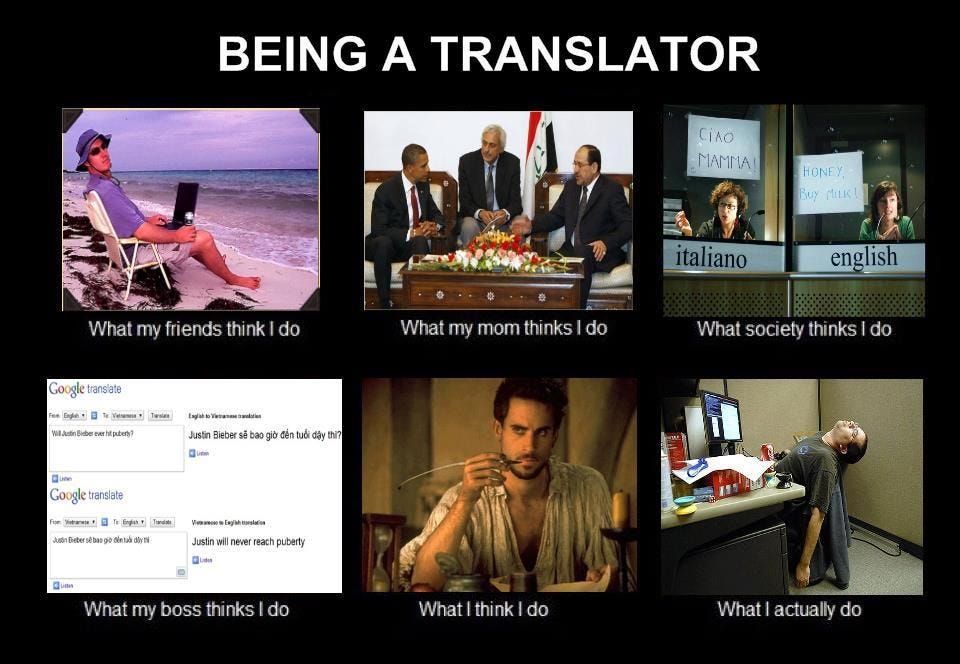
A peek into the life
My first real job interpreting was pretty simple. Low pressure, just acting as an interpreter and guide at a campground in Belgium. The camp hosts spoke English and German, the camp visitors mostly spoke French, so I was the liaison. I would be hard pressed to call this experience simultaneous interpretation because I had ample time to speak, think, and ask questions to clarify things that I may have missed.
On the other hand, I recently underwent a test for a simultaneous interpretation job that I failed miserably. I tell this story to illustrate a few things. First, there is always another level. You can always improve your language skills even if you have passed the C1 or C2 certification test. Interpretation is a skill entirely independent of your language skills because it involves different mechanisms than simply speaking and holding conversations with native speakers.
In this test I was tasked with simultaneously interpreting a TED talk about a medical student who went on to create a prosthetic device. The test was to listen to what she was saying in English and speak it aloud in French simultaneously. I had no control over the speed, the pause button, or anything really. Still, the first few minutes went well. I knew what she was saying and my summary was more than acceptable. However, about halfway through the 8 minute video I was too far behind. The video:
When I say “simultaneous interpretation” I mean precisely that. Hear one language and speak another translated in real time at normal speaking pace. Once she was two sentences ahead of me in the timeline I could no longer keep up while remembering what she was saying it and translating it simultaneously. I still had fun, though, and it was a good reminder of how much more work there is to be done. My excuse is that I am also teaching a Spanish class 3 nights per week which has certainly impacted my French.
How you can use this in your language acquisition
Now, how can you use this information to bolster your second language acquisition? We have discussed the advantages of translating in your head before, but this is the expert level of that exercise. Most of the time you will have several second if not minutes to think through different things and plan your sentences accordingly. If you take the time to try and interpret a one minute video one time every week, it will make those instances feel less intimidating.
Back when I was getting ready to take my driver’s license exam, my dad set up a cones to practice parallel parking. He set the cones 19 feet apart and made me try and try and try until I was able to reliably fit my car into that spot. The next day when I arrived to take the test, everything was normal until the parallel parking portion when I realized that instead of 19 feet, I had been allotted 25 feet to park.
This, essentially, is my approach to second language acquisition. Students I work with have seen this first hand, extremely high level inputs that make real life situations and conversations feel easier. Adding some simultaneous interpretation work to your language learning routine will provide an incredible return on investment.
One of the reasons this is so enjoyable is because you can explore new topics, but you can also work with materials you already know for a fact you enjoy. Whether it is interpreting YouTube videos, TV shows, TED talks, radio shows, or any other media source you consume regularly. It works especially well if you have already seen whatever it is you choose to interpret.
Ways to level up
In many cases you can test yourself on YouTube by putting the captions on and seeing if you are hearing everything correctly. When it comes to using YouTube, another advantage you have is the ability to control the video’s speed. If you are having trouble understanding what the people are saying at full speed, drop it to 0.75 or .5 if absolutely necessary. Do not stay there for too long, every day try to go back to full speed and only drop down if you are really struggling.
At the same time, do not be afraid to pause and rewind the video. Rarely will you get everything the first time, going through the material over and over and making it further through the video with each attempt is fantastic. There are very few people who would even attempt to use interpretation as a second language acquisition method. It is extremely difficult, but you will learn the language inside and out.

Changing material will keep the exercise feeling fresh and allow you to explore a variety of topics. If there is a video of something in your native language on YouTube, chances are there is a video of that very something in your target language. Finding them can be a challenge, so if you need help with that simply reply to this email or reach out on social media.
Conclusion
Simultaneous interpretation is probably one of the most difficult jobs a bilingual can get into and using it as a strategy to learn a new language may be a bit intense. However, you will be translating things in your head when you are learning how to speak. This is simply a way to expedite that process and train you to truly master it. With all of the technology you have at your fingertips, it has never been more accessible or filled with as much variety.
If you want to take this to the next level, write down the new vocabulary words you learn, write down things you get correct immediately, write down everything and take time to look up the words you do not know. This exercise will likely be exhausting. Starting with a one minute video is just as good as starting with a ten minute video. Whatever you do, just start.

Eager for more Second Language Strategies?
If you work in healthcare, I’ve built Medical Spanish and French Handbooks with dozens of clinical patterns and vocabulary frameworks you won’t find anywhere else. Available to paid subscribers.
I also build custom courses for professionals. Doctors, nurses, engineers, and anyone who needs targeted language skills for their field. Every program is tailored to your specialty, your patient population, and your schedule. Learn more and get started.