

Welcome, aspiring polyglot! While this post is primarily targeted at people who are already bilingual, much of the information will be transferable irrespective of where you find yourself in your language acquisition. In fact, using these strategies may help you to better understand the language you are currently learning while dipping your toes into another language altogether. At least that’s what they did for me.
Learning a language with a language
We have written before about ways to maintain multiple languages and strategies for learning multiple languages at the same time, but here I would like to discuss using your second language to learn a third or fourth. It sounds difficult, because it is. However, that does not mean it is not worth trying, especially if you plan on learning more than just one other language in your lifetime.
When I was living in Belgium as a Rotary Youth Exchange student, I was prohibited from taking English class, which I initially found rather irritating. Fortunately, I was attending a private school so German and Dutch were not the only other options. My particular school offered Spanish class as an option and so I took that, having learned Spanish in depth living in Costa Rica a year before.
What I did not realize, at the time, is that there is quite a bit of overlap between French and Spanish and, while the pronunciation is drastically different, the vocabulary and grammar are pretty similar. As most of you know, facing down a new language in its entirety can be rather daunting. But when you already know a similar language, or a language within the same linguistic family, things make quite a bit more sense.
Oddly enough, I have never in my life taken a French class in English. Every French course I have ever been a part of was either given in French or, in this case, Spanish. The teacher was speaking French in the Spanish class, but if I had a question or needed clarification I could ask in Spanish. Unfortunately she did not speak English, but it wouldn’t be complete immersion if I was able to default back to my mother tongue whenever I felt overwhelmed now would it?

How can you add this to your routine?
For illustration purposes I am going to use the same languages I learned using this method, but just know you can use whichever languages you are learning in the same way. The first thing you have to realize is, if something is being done in your native language, it is being done in your target language. It is easy, especially as Americans, to feel like everything is done in English. You have to get out of this mindset if you want to accelerate your language acquisition.
French speaking people are learning Spanish, Spanish speakers are learning Portuguese, Portuguese speakers are learning Italian. This holds true for just about any language you can think of barring a few hyper specialized or dying languages. So instead of looking for video explanations of vocabulary words or grammar structures in English, search for them in your second language.
For example, if you are learning Spanish, and you already speak French, I guarantee there is someone on YouTube making videos in French that discuss ways to learn Spanish. In a single search, less than 30 seconds, I was able to find countless videos that can help you learn Spanish as a French speaker, this is what that looks like:
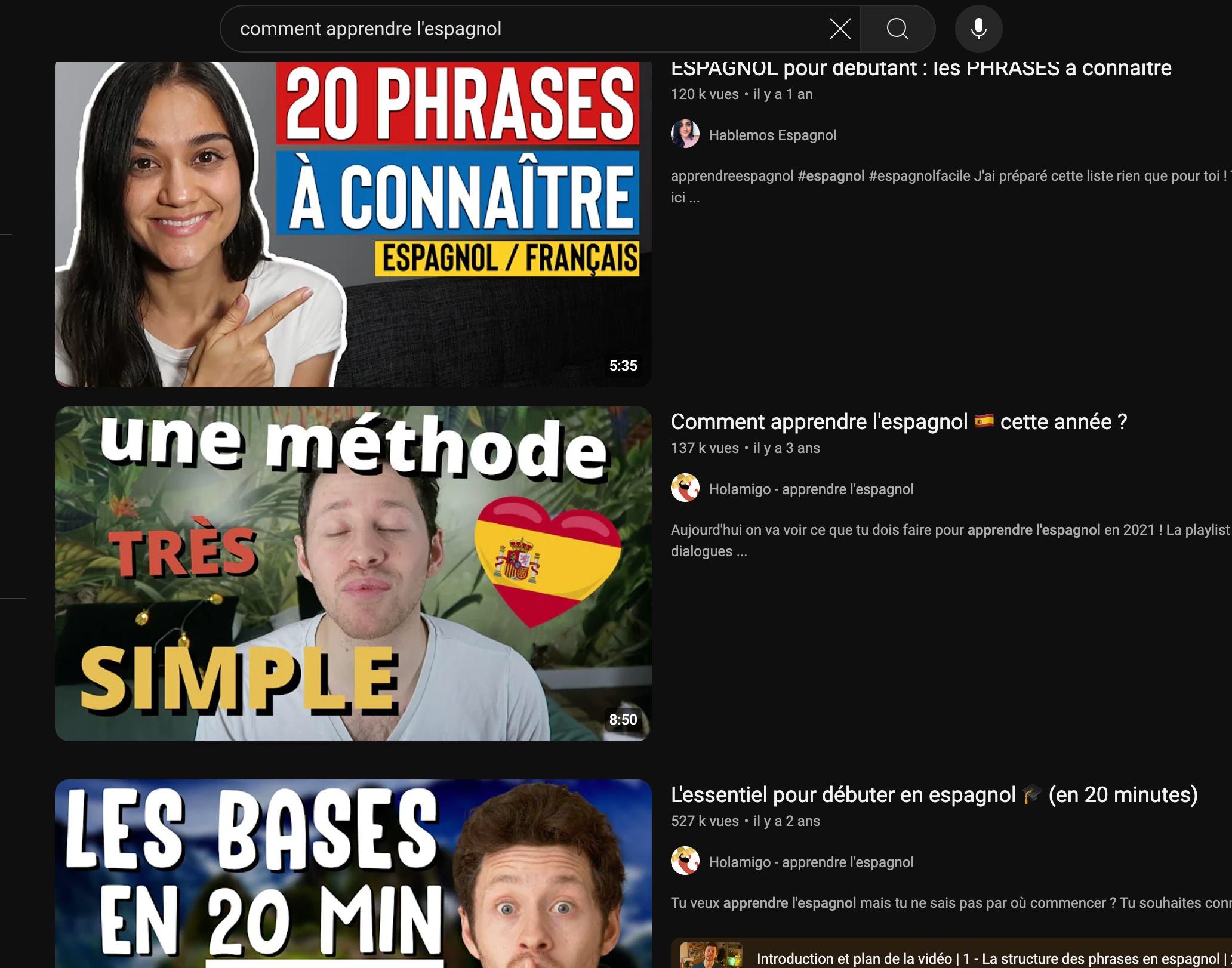
You can do this in just about any language and, if you are bilingual, the search portion should not be difficult at all. However, if you are struggling, comment below and I will help you figure out a search for your languages. The best part about these is they (mostly) come with built in subtitles so you don’t have to stress about catching every single word by ear alone.
Ways to level up
As per usual, there are levels to these things that can help you expand so you do not get too comfortable. Keep in mind that when you always listen to the same voice you are handicapping yourself as it will be difficult to understand someone else who has a different tone, inflection, and cadence to their speech. Diversification of content should be your first move to ensure you are getting a well rounded view of both your second and third language.
From there, writing down the overlaps is crucial. There is no reason to try and learn something you already know again. When it comes to Spanish and French, pay attention to the grammar and the reasoning behind different things. Both languages have multiple forms of the past tense, but the rules for when to use each are identical. If you can properly identify the times when you need one verses the other in French then you can recognize the same in Spanish.

Just as important as following the overlaps is making note of the differences. Any time you see something and say to yourself, “huh, I really thought these would be the same across languages and they aren’t” make a note of that. Similarities and differences are equally important and if you learn both then your understanding of each respective language will be greater. Then it will be time to take it to the final level.
The last thing you will want to do is start flipping the script. By that I mean, rather than looking for videos that teach Spanish in French, look for videos that teach French in Spanish. This will test not only your Spanish comprehension, but your French as well. Are you really as good as you think you are? Now is the time to find out! Remember, you can do this in just about any language you want with the power of YouTube.
Conclusion
There are millions of ways to learn a new language. If you already speak two, you have even more options. Learning a third language by using your second language will not only ensure you don’t forget your second language, it will also deepen your understanding of every language you do know. At the end of the day, you do not have to know everything about a language in order to speak it fluently. I learn new words in my native language on a weekly basis and I have been speaking it for almost thirty years.
Many people are able to speak fluidly without understanding every single rule in every single language they know. But with each subsequent language those rules begin to make more sense and that deeper understanding results in a smoother and quicker language acquisition. This method is not for the faint of heart. It will be exhausting, potentially demoralizing, but ultimately invigorating. The first time you do it will be the worst, but with each new experience things will get easier.

As we discuss often around here, creating is vital in second language acquisition. Speaking and practicing with written language will help you in accelerating and enhancing your language learning process, so start having conversations as early on as possible. It will be difficult, but you can do difficult things and be great. So go do some difficult things and become great.
Eager for more Second Language Strategies?
Second Language Strategies is a reader-supported publication. The strategies in this post are a fraction of what’s available to paid subscribers. The full Guides library, including The First 30 Days blueprint and advanced acquisition frameworks, is waiting for you on the other side.
If you’re ready to stop reading about language learning and start doing it with personalized instruction, learn about my private courses here. 28 out of 28 students have spoken their target language after completing the program.